









2025-2026 Advanced Biology Syllabus [close]
FREQUENTLY ASKED QUESTIONS
- What will I learn in Advanced Biology?
- What do I need for class?
- What will this course be like?
- Where do I prepare and keep my coursework?
- What if I am late handing it in?
- What is so great about the way we take notes?
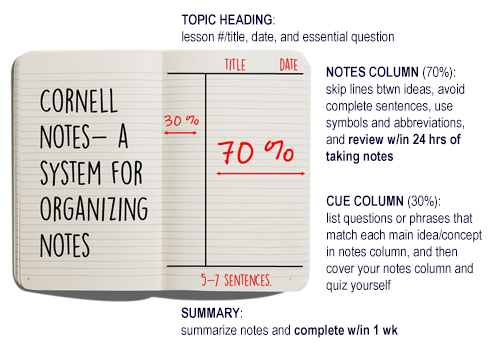
- What do Cornell-style notes look like?
- What if I get stuck when I am trying to learn?
- What if I have a question outside of our scheduled class period?
- What is the grading scale for this course?
- How will I be graded?
- Can I REDO coursework?
- What expectations do you have for me?
- What are my school-wide expectations?
- If I make the poor choice of being disrespectful, what are my consequences?
- What can I expect from you, Mrs. Steinbach?
WHAT WILL I LEARN IN ADVANCED BIOLOGY?
Advanced Biology is a rigorous course designed to provide an overview in the tentative ares of basic biology and biochemistry, anatomy and physiology, genetics, nutrition, microbiology, and medicine. This will be accomplished using a active, guided inquiry approach.
[top]
To be successful in this class you will need to have the following items with you daily.
- Your school issued iPad.
- A composition-type notebook (one per semester). This notebook will serve as your scientific log. It is a place to record all of your studies, meaning laboratory results and analyses, informational notes, reflections, etc.
- A number 2 pencil with an eraser.
The following items will be provided by me and available in our classroom.
- A scientific calculator (e.g., TI-30Xa).
NOTE: A partial classroom set of calculators will be available for use.- A set of markers and/or colored pencils.
- A scissors.
- Elmer's glue, a glue stick, tape, or double-sided tape for interactive scientific notebooking.
- Highlighters.

[top]
WHAT WILL THIS COURSE BE LIKE?
Advanced biology lessons will infuse various inquiry-based, active learning practices. Our learning environment will encourage scientific thinking and the exploration of real-life, meaningful studies. This is done with the hopes that you are more engaged in the learning process and therefor more easily demonstrate mastery of the more advanced biology concepts and practices.
[top]
WHERE DO I PREPARE AND KEEP MY COURSEWORK?
Do your very best to complete all your studies in your notebook, preferably in pencil when problem-solving, unless otherwise instructed. Then, you will be asked to (1) turn in, (2) report, and/or (3) reflect upon your studies recorded in your notebook.
WHAT IF I AM LATE HANDING IT IN? Coursework must be turned in when requested. Doing otherwise is detrimental to your academic progress. To help, in most cases, you will be provided with a floating deadline. For example, your lab scientific explanation will be due on Monday, Tuesday, or Wednesday of next week. An extension may be given for an emergency/special situation. Our late work policy is as follows:
- "Scrimmage" or mid-checks for understanding submitted late, while still in the unit, will be allowed a maximum score of 80%.
- "Game"/"Match"/"Meet" or end-checks will be accepted for full credit.
[top]
WHAT IS SO GREAT ABOUT THE WAY WE TAKE NOTES?
We will blend Interactive Notebooking and the Cornell Note-taking System in order to maximize our learning efforts. Your notebook will therefore not only serve as a log of your scientific studies, but also as an awesome study tool come test time. The research on the effectiveness of these two techniques is plentiful and solid.
WHAT DO CORNELL NOTES LOOK LIKE? Below is a quick overview of the system.
[top]
WHAT IF I GET STUCK WHEN I AM TRYING TO LEARN?
If you should have moments of struggle in this course,
- start by being resourceful and try to leap over your own hurdle. If you can overcome your challenge on your own, research shows that you are more likely to retain your newfound knowledge. Great resources to utilize include talking with a classmate, reviewing your notebook, completing an Internet search, etc.
- However, don’t spend too much time struggling. Please take some time to visit with or email me. I will be happy to help you to get to the root of your concerns and establish a plan of action that provides additional scaffolding (e.g., individualized instruction, graphic organizers, targeted problem-solving opportunities, etc.).
WHAT IF I HAVE A QUESTION OUTSIDE OF OUR SCHEDULED CLASS PERIOD?
To follow are a few options for you.
- Schedule a meeting before school, during flex period, or after school.
- Send a message to me via email.
FYI, please know that I will be monitoring your growth through "scrimmage," or mid-check, assessment opportunities and will initiate a meeting and/or plan of action if necessary. Your academic success is very important to me.
[top]
WHAT IS THE GRADING SCALE FOR THIS COURSE?
Grades entered into the gradebook will be based on proficiency.
Mastery Proficient Approaching
ProficiencyDeveloping
ProficiencyInsufficient
EvidenceA
means you have advanced understanding of the science content/skill.B
means you are proficient in your understanding of the science content/skill.C
means you are still developing your understanding of the science content/skill.D
means you are beginning to have understanding of the science content/skill.F
means there is insufficient evidence at this time (i.e., missing assignments to demonstrate understanding).
92-90.... A-
86-83..... B
82-80..... B-
76-73..... C
72-70..... C-
66-63..... D
62-60..... D-[top]
WHAT ASSESSMENTS WILL YOU ENCOUNTER? Your grade will be determined by making a number of checks for scientific understanding, as well as application and critical thinking skills. Assessment examples include:
- Pre-assessments are assessments that occur before the learning in order to establish a baseline for growth or before a major assessment.
- "Scrimmage" or mid-check assessments are assessments that occur while you are still learning. An analogy would be when the cook tastes the soup he/she is making in the kitchen before serving it.
- "Game"/"Match"/"Meet" or end-check assessments are those that occur at the end of the learning period. An analogy would be when the customer tastes the soup made by the cook.
- At the end of each semester, you will take a comprehensive final exam. You will be allowed to use your scientific notebook during this assessment.
- Portrait of a Gilman Graduate evaluations will help us to show that you've gained skills that will allow you to thrive in your future life. Examples of such skills that we will focus on include: autonomy, belongingness, goal orientation, efficacy, individual hope, and engagement.
Through these assessments, your mastery or proficiency level will be determined. Your proficiency level will then be converted to a percentage equivalent/point value for Infinite Campus calculation purposes. For example:
- 10 = mastery, 8.5 = proficient, 7.5 = approaching proficiency, 6.5 = developing proficiency
- 100-90 = mastery, 89-80 = proficient, 79-70 = approaching proficiency, 69-60 = developing proficiency
You should choose to complete any REDO assessments for full credit, unless the assessment is turned in late.
Scientific Practice (“Scrimmage”) Scientific Performance (“Game”/”Match”/”Meet”) These mid-check assessments are like a scrimmage. They tell you and I whether you are making progress in your learning. These assessments are like the final big game, match, or meet. We use them to see what you know and/or can do. These assessments will be reviewed and graded by you and/or I. These assessments will be reviewed and graded by me. Selected assessment scores in this category will be worth 10%. Selected assessment scores in this category will be worth 90%. Examples of such assessments include: pre-assessments, investigate checks, check-ins, project checkpoints, etc.
NOTE: A select set of these assessments, chosen by the teacher, will be moved into the Scientific Performance grading category.Examples of such assessments include: some teacher chosen scrimmage assessments, CER work, tests, lab practicals, etc. HOW WILL MY QUARTER AND SEMESTER GRADE BE CALCULATED? Now that you understand the types of assessments you will encounter, let's look at how your grade will be calculated.
Your quarter grade will be determined through a weighted system.
- 0% Pre-assessment
- 10% Scientific Practice ("Scrimmage")
- 90% Scientific Performance ("Game"/"Match"/"Meet")
- 0% Portrait of a Gilman Graduate Evaluations
Your semester grade will be determined through a weighted system.
- 45% Quarter A
- 45% Quarter B
- 10% Comprehensive Semester Final

Test Format Note: On tests, questions will be subdivided into three levels of questioning or depth of knowledge (DOK) levels. The purpose of providing testing levels is to reward those who meet all foundation knowledge requirements, as well as reward, not punish, those who attempt more challenging test questions. What are levels?
- Level 1 (Acquired Knowledge)
- Provides an opportunity to demonstrate foundation knowledge.
- Question types used will include multiple choice, true/false, etc.
- Successful completion level 1 earns a grade of C or developing mastery.
- Level 2 (Knowledge Application)
- Provides an opportunity to demonstrate application of foundation knowledge.
- Question types used will include complex multiple choice, completion, short answer, problem, etc.
- Successful completion level 1 and level 2 earns a grade of B or proficient mastery.
- Level 3 (Analysis)
- Provides an opportunity to demonstrate real-world/complex understanding through strategic use, analysis, and manipulation of foundation knowledge.
- Question types used will include short answer, problem, essay, etc.
- Successful completion of level 1, level 2, and level 3 earns a grade of A or advanced mastery.
Infinite Campus Gradebook Note: Coursework that has NOT been handed in (i.e., it is late or you were absent) will be marked as missing. Marking an assessment as missing scores that assessment with zero value and will lower your overall grade.
[top]
You will be allowed to reflect upon and resubmit "Scrimmage" and some "Game"/"Match"/"Meet" assessments. So, take advantage because learning from your mistakes is the best learning. :)
[top]
WHAT EXPECTATIONS DO YOU HAVE FOR ME?
TAKE CHARGE OF YOUR LEARNING… Have pride in yourself and your science studies. Be curious and ask questions. Dig in, stay focused, and contribute your thoughts and skills. Hard work today will help you to have the future life you are dreaming of.
(Yep, you're right. Actually, that's a steer.)
CONDUCT YOURSELF PROFESSIONALLY WITH KINDNESS AND INTEGRITY… Because learning is currently our number one occupation, professional appearance and conduct matters. Be a team player. Share your ideas and talents with your classmates, but do so with kindness and integrity. Academic dishonesty (e.g., cheating and plagiarism) in any portion of your academic work is a serious offense. More importantly, academic dishonesty will hurt you in your attempt at future coursework that relies on the learning.
Academic Integrity Video from Michigan Tech
BE PRESENT AND PREPARED… Don’t miss a day to learn something new and become a better person. Be present for scheduled class periods and participate fully from start to finish. Be prepared by doing the work necessary to achieve the learning (e.g., take notes, complete practice problems, etc.). Don't let your personal device(s), etc. distract you. Presence and preparedness are essential to maximize your learning experience.


(Go Pack Go!)BE SAFE IN THE LAB… Your safety and the safety of your classmates and I is important. You will be required to sign and abide by a student safety contract, as well as always follow class lab/activity directions in order to participate fully. If you fail to do so, you will not be allowed to participate in laboratory activities and you will not have opportunity for make-up.


TAKE CARE OF OUR CLASSROOMS… Help me to keep our resources, supplies, and lab materials in great condition. I love our classrooms and I hope you do too. Keep your desks and lab stations clean and free of doodles. (If you can’t resist the urge, doodle in your notebook.) If something is broken, report it to me right away. If the lighting or room temperature is not quite right, let me know and I will do my best to get it fixed. We will work best in a nice, neat, and clean classroom.
WHAT ARE MY SCHOOL-WIDE EXPECTATIONS? These expectations, both rights and responsibilities, can be found in your Student/Parent Handbook. Our classroom expectations compliment and abide by these expectations. To read this handbook, visit the Handbooks and Documents page and then click on "Student/Parent Handbook."
[top]
IF I MAKE THE POOR CHOICE OF BEING DISRESPECTFUL, WHAT ARE MY CONSEQUENCES?
It is my belief that every student has the right to be educated in a welcoming, respectful, and safe learning environment. Thus, misconduct will be dealt with accordingly.
- Misconduct in the Classroom, depending on severity
- First Offense...Warning
- Second Offense...Detention
- Third Offense...Removal
- Misconduct in the Lab
- Removal
[top]
WHAT CAN I EXPECT FROM YOU, MRS. STEINBACH?
COMPLETE DEDICATON TO YOUR ACADEMIC GROWTH…
I will be your biggest academic backer and constantly encourage you to do your best work.
I will challenge you.
I will ensure that other students do not disrupt your learning.
I will do my very best to provide you with a variety of meaningful and fun learning opportunities that will help you to grow intellectually.
I will foster your creativity, critical thinking practice, and problem-solving ability.
I will help you to boost your understanding and confidence when you feel overwhelmed.
I will treat you fairly with the respect and dignity that you deserve.
I will do all of these things because I believe in you and your abilities.
[top]
GO PIRATES!
Gilman Middle/High School
325 N Fifth Ave
Gilman, WI 54433